Category: Current Events

  • The Founders’ Circle

    The Founders’ Circle

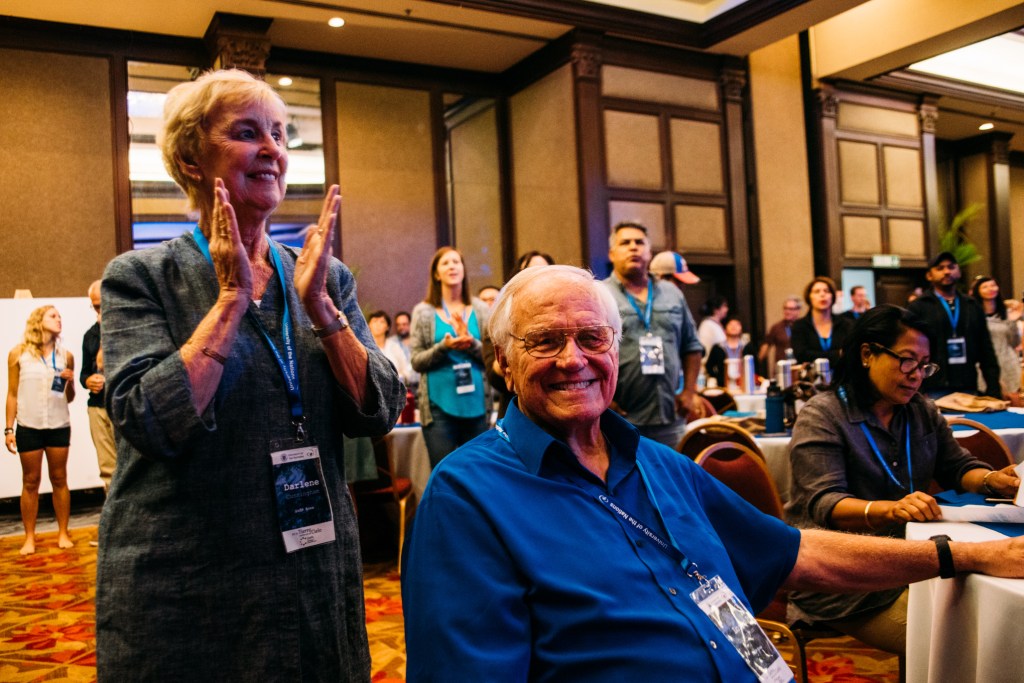
    Some have responded to my recent post about succession and asked, “Who is on the FC and what does it do?”  Here is an excerpt from something Darlene Cunningham wrote a several months ago;

    The Founders’ Circle (FC) was formed by Loren and Darlene Cunningham to draw together an eldership group around their leadership as the founders of Youth With A Mission. The primary purpose of the FC is to stand in unity and prayer over the mission and to serve as guardians of YWAM’s Purpose, Core Beliefs and Foundational Values; our Four Legacy Words, and the YWAM Covenants. It is not a governing nor representative body. The FC meets several times per year in person and/or via Zoom.

    Those called to serve alongside Loren and Darlene on the Founders’ Circle as of March 2023 are:

    John Dawson
    Lynn Green
    Tom Hallas
    Jim Stier
    David Hamilton
    Markus Steffen
    Maureen Menard
    David & Sue Cole
    Sean Lambert
    Ken & Robyn Mulligan
    Paul and Susi Childers
    Garth Gustafson
    Giacomo Coghi
    Paul Dangtoumda
    Edwin Fillies
    Silo Schmidt
    Mark Anderson

    This is not a fixed membership body; it changes from time to time, and it is likely that more changes in the composition of the FC are likely in the next few months.


  • The Big Question: YWAM Succession

    The Big Question: YWAM Succession

    March 2023 – Lynn Green


    Dear YWAM,

    There were many tears at the Founders’ Circle meeting earlier this month at Loren and Darlene Cunninghams’ home, as we met for the first face-to-face gathering in more than three years. Loren had just undergone extensive health scans and tests and the results reached them as the FC began. (The Founders’ Circle is a group of about 15 mature YWAM leaders invited by Loren and Dar to take responsibility with them for guarding the vision and values of YWAM and to exercise eldership for this movement, especially in the area of prayer.)

    The reports from the specialist came in two parts. The first one gave us notice that the results were not good news. With the second report came the doctors’ verdict: Loren’s condition was cancer that had spread throughout his body, and it would be terminal.

    Loren’s focus as he shared with the FC during those days was on delivering his primary message, which has been developing for most of his life, but has accelerated over the last 20 years. With unexpected energy and clarity, he spoke about the importance of translating the Scriptures orally for every person on earth, in their mother tongue. We were all deeply convinced that this is our God-given task, along with thousands of current YWAMers and tens of thousands to come. Loren was encouraged to know that we embraced the spirit of what he was saying and will pass it on. After his extensive input over the space of three days, Darlene asked him if he was satisfied. He replied with a big smile and affirmation.

    But although the FC received his message and made commitments to do it, OUR central focus was on the implications of the news from the doctors.  We couldn’t avoid it.

    We surrounded Loren and Darlene with prayer and tears. Paul Dangtoumda, leader of YWAM Port Harcourt, Nigeria, wept and prayed, “The doctors have given their verdict, but that is not God’s verdict. We will believe what God says.”

    The medical team said that Loren’s cancer “has not presented as a classical case.”  What they explained is that when cancer is discovered in the lungs, it usually moves very fast but, in this case, it is moving more slowly.  We thanked God for that good news and prayed that Loren will have every day on earth that God has ordained. This was not a faithless time; it was a faith-filled time, because God has always been faithful.

    Of course, we all knew that the day of Loren’s departure would eventually come; it does for everyone. And what a glorious hope and promise eternity with Jesus contains! Loren often revels in proclaiming “Heaven is for real!”

    But this sobering cancer diagnosis provoked us to examine the more immediate personal implications.  Grieving and a sense of impending loss are appropriate – and when the time comes, we must take time as a global family to grieve and honour this amazing man that God has privileged us to follow.

    But what comes next for YWAM?

    For the past several years, I have often been asked, “Does YWAM have a succession plan for when Loren is no longer with us?” When Darlene wrote on March 1st about Loren’s cancer diagnosis; that letter raised the succession question in many more conversations around the world.

    My purpose in writing this letter is to answer that question.

    The answer has been in plain sight for the past 60+ years but we almost always wear cultural blinders that prevent us from seeing YWAM leadership plans for a future without Loren.

    The fact is, the days without Loren are coming.  Are we ready? I maintain that Loren himself started preparing us for this from the start of YWAM in 1960, when he had a clear word from God that “YWAM is to be decentralized.” Then the entire mission began preparing from the early 1970s. I was there in 1972 when the amazing Munich Olympics outreach finished and about 100 YWAMers gathered for the biggest staff gathering ever up to that point in time. The main purpose of that meeting was for Loren to announce the membership of the [1]International Council. He made it clear that he had never intended to lead YWAM alone or sit at the top of an organizational hierarchy.  He initially appointed five others to join him as an eldership for YWAM as it rapidly became a global, multicultural movement.

    That group grew, changed, grew some more and consistently gathered at different locations globally to provide wise eldership for the movement. Loren was the obvious “senior among equals,” but the other members and many other leaders grew in wisdom and impact across the nations.  We eventually developed a [2]Global Leadership Team with an executive group.

    But that somehow didn’t seem right.  We were following the model of almost every other mission and denomination, but our sense of family and unity suffered. The usual hierarchical approach didn’t seem to fit us.

    In 2002 and 2003, we started a journey back to the decentralized way we saw ourselves 40 years earlier. Loren went on an eleven-day fasting and prayer retreat and then joined the GLT gathering in Nanning, China. There he presented a teaching on Spiritual Eldership that became known as the “Tripod Message.”  You can remind yourself of what he taught by going to https://ywam.org/for-ywamers/spiritual-eldership

    We are meant to exercise leadership within a BODY model. Look at Ephesians 4 or, Romans 12, or 1 Corinthians 12, or reread Acts 15 to see how the early leaders of the Church resolved difficult issues and provided secure leadership.

    As we review the book of the Acts of the Apostles, we see that some foundational leaders were martyred in the early years, but the Church continued to grow dramatically. Some have suggested that Peter was the senior leader of the early Church, but an attentive reading of the early story demonstrates otherwise. The apostles, then the Jerusalem elders and prophets and deacons led as a body.

    Leadership in the body metaphor results in different leaders leading at different times, according to their gifts and callings and the need of the moment. When an evangelist with boldness was needed, Peter was the leader of the moment. When a very sensitive issue with huge implications arose, James took the lead. He had the ability to process the issue in such a way that everyone had a chance to make their position known; then he allowed Peter to speak, followed by Paul and Barnabas. No further discussion was allowed; James simply stated the decision of the gathering of leaders, then prescribed a wise process of implementation. His leadership averted a huge crisis in the young Church and Peter’s preaching was the catalyst for thousands of conversions.

    I could go on, but I want to apply this to YWAM at the point when we are faced with developments that prompt us to consider YWAM without Loren.

    I first want to say that Loren’s passing will have a personal impact on me, and upon every individual YWAMer, that we cannot predict. His intervention at several decisive points in my life has been crucial. I can only say that if Loren Cunningham had not come into my life, my life trajectory would have been completely different and much less fruitful, rich, and satisfying. Probably all of us can echo the same.

    Some have asked, “Who will be the global visionary?” My response is another question, “Must we have one?” Loren has left enough vision for several more generations! But if we do need one (or more) global visionaries, God will raise them up!  We cannot appoint such a person, but if the hand of God rests on one or more people to point the way ahead for the entire mission, we will discern that and recognize them.

    YWAM will be well led if we have a good BODY of leaders who love one another and guard the oneness that Jesus has created for us.  This most recent meeting of the Founders’ Circle was marked by easy harmony and oneness.  Let’s pray for that oneness at every point of leadership in the mission!

    Most of us spend most of our lives in hierarchical leadership structures. Most families are hierarchical, as are schools, universities, jobs, clubs and civil organisations, government at every level, as well as most churches and denominations. It is no surprise that we struggle to understand a body approach to leadership. This way of looking at it is not perfect because everything we do in this fallen world has weaknesses. But I believe we will lead better and follow better as we aim for body life in all aspects of what we do.

    Do we have a plan for succession?  Yes!  It’s the way God has directed from the beginning.

    [1] 1972 The first International Council members were: Loren Cunningham, Leland Paris, Don Stephens, Wally Wenge and Jim Rogers; later added Floyd McClung, Kalafi Moala, Lynn Green and Jim Dawson. (Source: YWAM Founders’ Timeline.)

    [2] 1995 At the International Council/International Executive Committee meeting in Einigen, Switzerland, YWAM formed a new Global Leadership Team (GLT), broadening its structure to incorporate more non-westerners, women and young leaders. Jim Stier was chosen as the YWAM International President, receiving that role from Loren, and Loren Cunningham became the International Chairman. (Source: YWAM Founders’ Timeline.)

    [i]  “[In 1972]…the International Council (IC) was the recognized global eldership of the mission. Since that time the senior circle of global elders has functioned under several different names. First it was the International Council (IC). It was later called the Global Leadership Team (GLT) and then was known as the Global Leadership Forum (GLF). This body was disbanded in Singapore 2014 in order to put in place a flatter, movement framework at the trans-local level in the place of what was becoming an increasingly hierarchical organizational structure. Now there are many circles of spiritual eldership around the mission – many of them known as Area Circle Teams (ACTs). A senior group of elders has been convened by Loren and Darlene Cunningham and is known as the Founders’ Circle (FC).

    Throughout these many decades, a primary role of the body of global spiritual elders (whether the IC, GLT, GLF or FC) has been to confirm, steward and safeguard the foundational documents of the mission. Though the FC does not have the governmental oversight of earlier leadership frameworks, it does carry this role of protecting and clarifying our foundational documents.” Source: Historical Note at the end of “The Youth With A Mission Statement of Purpose, Core Beliefs and Foundational Values” (January 2022).
    the International Council (IC). It was later called the Global Leadership Team (GLT) and then was known as the Global Leadership Forum (GLF). This body was disbanded in Singapore 2014 in order to put in place a flatter, movement framework at the trans-local level in the place of what was becoming an increasingly hierarchical organizational structure. Now there are many circles of spiritual eldership around the mission – many of them known as Area Circle Teams (ACTs). A senior group of elders has been convened by Loren and Darlene Cunningham and is known as the Founders’ Circle (FC).

    Throughout these many decades, a primary role of the body of global spiritual elders (whether the IC, GLT, GLF or FC) has been to confirm, steward and safeguard the foundational documents of the mission. Though the FC does not have the governmental oversight of earlier leadership frameworks, it does carry this role of protecting and clarifying our foundational documents.” Source: Historical Note at the end of “The Youth With A Mission Statement of Purpose, Core Beliefs and Foundational Values” (January 2022).

  • Align for Blessing

    Align for Blessing

    ©Photo by Joshua Woroniecki

    I once produced a livestream on the subject of Alignment.  Within a couple of days I was dismayed to discover that one of my viewers posted a comment in which labelled it as cultish.  I then sounded it out with others who had some sympathy with that interpretation.  I felt unfairly judged!  But in the long run, it was helpful, because it became obvious that my language on the subject must be well-defined. So here is an attempt to clarify.

    The term, as it applies to Youth With A Mission and probably many movements and organisations, came to my attention via my friend John Dawson.  When he was commissioned to be International President of YWAM in 2003 in Singapore his inaugural message was entitled “Alignment”.  John has a great gift for using words accurately, so I think the subject was well and widely understood.

    His point and mine was that when we align ourselves with God’s will, we live in the middle of His blessing.  That doesn’t mean in the middle of ease and prosperity.  As nearly every committed Christian knows, living in the centre of the will of God is sometimes painful, but it’s always the pathway to the greatest lasting fruitfulness your life or mine can bear.  I think it was Gregory Boyd who said, “Life on this earth is best understood as living in a war zone”.  However, Jesus is the Captain of the Hosts of the Lord, and He has said in John 10:10 “My purpose is to give you a rich and satisfying life”.  So we might say “battle and blessing” summarises the life lived well.

    The aligned life remains in the place of victorious battle and blessing.

    Alignment applies to different aspects of our lives.

    Firstly, there is alignment with God’s ways as revealed in Scripture and applied to our lives by the Holy Spirit.  We cannot disobey His commandments and expect Him to bless our lives.

    It also refers to alignment with His specific guidance to each one of us.  Peter says in his first Epistle “we are a royal priesthood”. Each one of us lives in His presence, hears His voice, and has the grace to follow Him, so we must choose to stay aligned with His calling on us individually.

    If we are part of a church or a mission, we should be aligned with the particular calling of that body of people.  As a member of Youth With A Mission I should resonate with our beliefs, purpose, values, and legacy words.  The more I am aligned with God’s calling on YWAM, the more fruitful I will be.

    There is one more facet of alignment, which is where the controversy came when I mentioned it in the livestream.  We are to be aligned with leaders in our lives.  The problem arose because some people thought that meant unquestioning obedience.  But that is not it at all!  We are aligned when we maintain an open, honest relationship where agreements and disagreements are possible without disrupting the relationship.

    Can you easily identify those with whom you should be aligned?  For me, it has been the team of leaders with whom I lead locally, and it also applies to my relationship with Loren and Darlene Cunningham and those who comprise the team of international YWAM elders.  Loren and Dar have been faithful, honest leaders of great character, so alignment with them has almost always been easy.  However, there were a couple of occasion when I disagreed with Loren and didn’t do what he wanted me to do.

    For example, many years ago Marti and I felt we were to take our children to spend a few weeks with my extended family in Colorado, where they had many cousins of similar age.  We were there and enjoying watching the friendships between cousins, aunts and uncles and grandparents deepen when Loren phoned.

    He said he and Joy Dawson had been praying and they felt the Lord told them to call and tell me I should be at the international outreach in Canada that summer.  I explained that we were pretty sure that I should be with Marti and the Kids in the USA.  I agreed to pray about it.  Marti and did pray and felt I was not to go.  Loren rang again to say that several of them were praying together and felt I should be there.  Again, I said no.

    I think in some organisations or churches, the senior leader would have reacted angrily, but Loren didn’t.  He respected that the “priesthood of all believers” included me and knew that no leader has the right to override the divine guidance of others.  He understood that, even if I was mistaken, I should not be there unless I knew that God wanted me there.   I did not obey him, but thanks to his maturity and graciousness, I stayed aligned with him.

    Not all people in authority understand that, but we should still be able to say, with the Apostle Paul when he was on trial, “I always do my best to be at peace with everyone”.

    Marti and I have now lived together in the context of our calling which is global missions, particularly as expressed in Youth With A Mission, for 54 years.  We look back on tests, trials, and hardships, but know that the summary of our experience is exactly what Jesus promised.  He has given us a rich and satisfying life (John 10:10 NLT).  That is because God loves to “give good gifts to His children”, but our part in that rich and satisfying journey is staying aligned—with His ways, His calling, and the people He has called us to be with and to submit to.  So, alignment, when understood that way will lead to God’s blessing on our lives.

  • Leadership: Malpractice and Abuse

    Leadership: Malpractice and Abuse

    Not long after Marti and I were married, and when we were in the first couple of years gaining some experience in leadership, we attended a seminar on issues that face youth.  It was a four-day event, and the speaker was outstanding.  He had attracted over 20,000 people to an arena and held their attention hour after hour.

    SUBMISSION??

    One of his subjects was submission to authority.  He had an amazing story of his struggles to submit to the leadership of a young man who was clearly arrogant and incompetent.  But when he did get his attitude right and trusted God for the humility to treat his “leader” with respect, it seemed the Holy Spirit entered into his difficulties and within a few weeks everything changed.  The young man was removed and the man who was presenting the seminar was promoted to leadership.

    He went on to teach about David’s attitude to Saul over the years when Saul was pursuing David to kill him.  The message was clear: always obey your leader!  If you do, God will make a way for justice to prevail.

    BUT YOU MIGHT DISOBEY!

    I was inspired and began to study the subject of leadership and submission in the scriptures.  It wasn’t long before I began to see exceptions to that rule.  One example was when, in Acts 4, the apostles were called before the religious leaders in Jerusalem and commanded to stop talking about Jesus.  The apostles, who faced the possibility of execution said, “You be the judge, shall we obey God or man?”

    I began to teach on submission and one session included how you or I could disobey our leader, but with a submissive heart.  I have recently reviewed that teaching and there is a video on the subject on my website.  Having said that, I would not want to teach that subject the way I did all those decades ago.

    WHAT DOES ABUSE MEAN?

    So much has changed!  Now it is more difficult than ever to navigate the terrain that arises when charges of abuse of authority have been made.  That word, “ABUSE” is a description that can be used to describe cult-like psychological manipulation and domination, but is also used as a charge against someone who just crosses our selfish interests in a manner that we don’t like.  I prefer to avoid the term, but I recognise that leadership malpractice is widespread and always has been.

    THE ONLINE MOB

    I think the biggest challenges related to this subject are due to the rise of social media.  We all know it is now possible for someone to charge another person with an offence and to do it so that the charge gains support from many people.  Then the online mob becomes a digital lynch mob.  Once that has been done, it is impossible to undo it and that information, or misinformation, is very hard to erase, even if the charge is shown to be false or exaggerated.

    Another one of the changes is more subtle and makes truth harder to be sure about.  Over a period of several years, beginning in the late years of last century, a new rule was created:  You should always believe the victim.  Or, more accurately, you should always believe and support the person who claims to be a victim.  That maxim was a direct attack on centuries of highly developed and principled processes that were designed to protect both parties in a conflict.  The Marxist view that social life is primarily a struggle for power and that the power of “the mob” should support the weaker person in the conflict, has come to dominate popular thinking and social media forums.  Therefore, “the mob” will almost always decide that authority figures, or the wealthy people are guilty.

    WHY IS JUSTICE BLIND?

    Justice has for centuries been represented by a female figure wearing a blindfold and holding balance scales in her hand.  It demonstrated that justice must be administered by weighing the facts, not by the appearance of the conflicted parties.  Now it might be more accurate to show her with the blindfold off and with a thumb on the side of the scale where the apparently weaker party stands.

    SOMETIMES THERAPY CAN HINDER RESOLUTION

    Some counselling guidelines can also hinder the process of discovering the truth.  It is widely understood that victims of abuse are usually traumatised and that any effort to have them face the abuser can be an occasion of further abuse.  I get that.  But it makes it almost impossible to find out what actually happened.  I will explain with an example.

    Let’s say I have been informed that a leader has been guilty of abusive behaviour and that a couple of the people on the receiving end of abusive leadership have come forward with charges of leadership malpractice.  Let’s also say that they perceive me to be in a position where I might be able to bring about justice.  They have been in counselling and are working through their trauma and they feel that the abuse must stop and I am responsible for making that happen.

    My first step is to say, “If I make a safe environment for you, will you sit in the same room and say to that leader what you have said to me and your counsellor?”  The answer is “no, I’m too afraid”.  So I check with the counsellor who confirms that they should not be asked to do that because it is likely to cause more trauma.

    So, I usually take another person or two with me and I go to the leader and explain the charges against her/him.  But he or she has very convincing explanations that demonstrate that the “victim” has a history of problems with leaders, and this is just another manifestation of those problems.

    Now what?  If I go back to the “victim” and tell her about the response of the leader, it will probably make things worse.  Shall I just decide which of them is likely to have the most truth in their story?  Then what?

    FACE TO FACE–BUT SAFE

    It is not difficult to see why the law requires an accuser to face the accused.  It is also Biblical.  Matthew 18 and other passages say you must go to the person who has offended you.  I understand that can seem impossibly difficult, but there is little chance of discovering the truth of what has gone wrong without being in the same room together.  I, as the person trying to help, have to thoughtfully and sensitively create an environment where the aggrieved person knows they will be protected from further harm.  (It is worth thinking about how courts of law do that.)

    MANY PERMUTATIONS OF THE SAME PROBLEM

    Spiritual abuse and general abuse of authority happens a lot!  It is often men in a position of power, who use that power to dominate others, or to manipulate people to obey them by using guilt or threats or enticements.   But female leaders can also be guilty of the same offences.  If we regularly read the news, we will see countless examples of government leaders bullying their staff, teachers assaulting or seducing students, bosses exploiting employees, using sexual favours to blackmail—it’s a very long list of abuse of power/authority.  When spiritual leaders become abusive it can be particularly damaging, so we must be alert and responsive guard against it.

    WE CAN GUARD AGAINST IT

    What can be done to protect against abuse?  The first guard is to avoid the development of leadership hierarchies that place one person at the top.  The healthiest leadership is team leadership.  And that does not mean one strong leader with a number of people working with/for him or her.  We should always work towards genuine plural leadership.

    Every person in leadership must concentrate on growing in humility.  I know I have sometimes become defensive when challenged, so I feel challenged and a bit self-conscious just writing the previous sentence.  But I can say I am still working on it.  In a recent conversation, a friend told me how incensed he was at the disrespect shown to me in an earlier meeting.  You may be surprised to know that that conversation made me feel pleased—because I had not been offended by the insults in the earlier meeting.  A small victory!

    THE WISDOM OF CALLING ON OUTSIDE EXPERTISE

    A wise leader or leadership team will invite a trusted person or team with wisdom to evaluate their leadership from time to time.  In the early years of the work of YWAM growing in England, my co-leader and I felt that things were going very well and, frankly, I was proud of all that seemed to be flourishing under our leadership.  From that position of apparent strength, we thought it would be a great idea to have a review of our leadership.  We invited an older, wiser leader to come, interview our staff and then give us feedback.

    At the end of three or four days of consultation with us, and those working with us, we sat down to hear the results.  He brought us down to earth with a thud!  We found that our co-workers were willing to tell the consultant things that they were reticent to tell us.  There was a long list of ways we could improve our leadership practices.  What a great assist to our efforts to develop humility!

    MORE PROTECTION, PLEASE!

    Leadership malpractice is widespread in all sectors of human society.  But that should never mean that we take it for granted and do nothing about it.  Leaders in mission movements and organisations, churches, religious charities etc.  Must take every report seriously and do their best to follow up with an inquiry into what is going on.  Over the years, especially in the early decades of the growth of the Jesus revolution and all the movements and organisations that arose from it, leadership malpractice was rife.  It was mostly out of ignorance and there was usually a lot of grace extended to inexperienced leadership.  Nevertheless great psychological and spiritual damage was done to some.

    So, we pray, we teach, we exhort, we support, we encourage, and where necessary we discipline.  We will never completely eradicate mistakes by people in authority, but that can still be our aim.