Category: Worldview

  • Congregating in the Egyptian Desert

    Congregating in the Egyptian Desert


    **This is a personal website and reflects my thoughts and convictions. It does not represent any official position held by Youth With A Mission.**

    CONGREGATING IN THE EGYPTIAN DESERT

    Why would two to three thousand people from dozens of nations gather in the Western desert of Egypt (between Cairo and Alexandria) just to worship and pray?  There were no guest speakers, and the very long sessions were mostly prayer and worship.  In fact at one point the whole group simply sang the name of Jesus (sounds like “Yassu” in Arabic) for nearly an hour.  Why would over 300 Chinese risk coming to the event, knowing they are likely to be questioned by the Police and possibly punished on their return?  Why would people pay their own way, then sit on buses travelling under armed guard from Cairo to the desert and back each day – a journey that took at least three hours?

    Described that way, it sounds like torture to me — especially the idea of being in a tent in the desert with the temperature approaching 40 degrees C.  But it wasn’t!  Something very powerful happened, of which I can only give you a glimpse.  In fact trying to describe this event reminds me of the Apostle Paul’s phrase that we “see through a glass darkly”. 
    THE COMPLEMENTARY BODY

    Perhaps it helps to think firstly about who we are.  We are all created as individuals, and we differ immensely.  Some of us are very logical and concrete and linear in the way we think and live – I am one of those.  Others are deeply moved by symbolic gestures, visions and dreams or connections that remind them of scripture passages.  This kind of gathering tends to attract more of the people who get visions and dreams and see great significance in what sometimes looks like coincidences to me.  I need these people, and they need me.  Together we represent body, as Paul writes in I Corinthians 12, and we can safely discern what God is saying and doing – at least as much as He wants us to .  But, there will always be mysteries.

    ANCIENT “GODS” IN MODERN TIMES

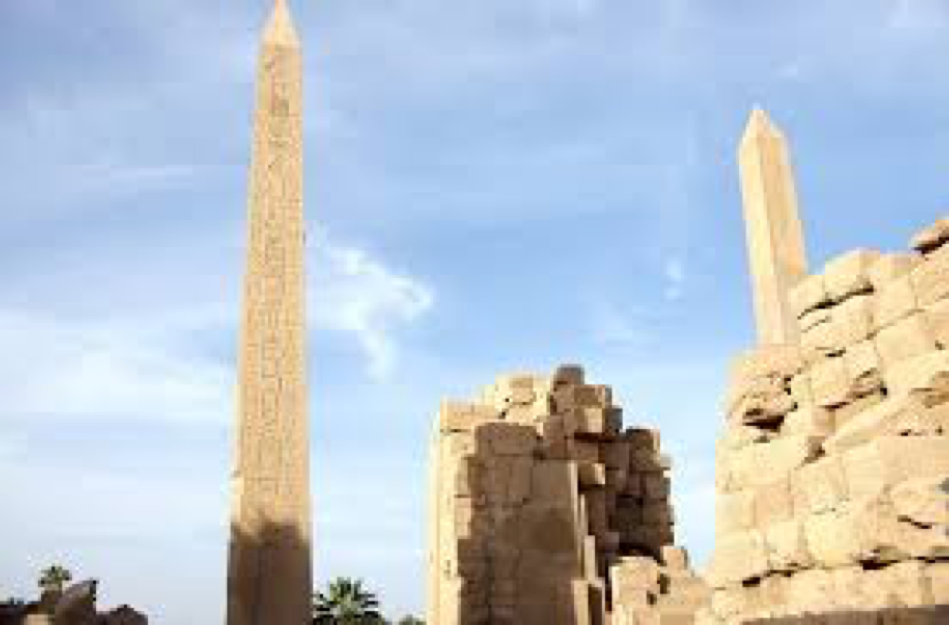
    Let me back up a bit, though.  It didn’t start in the Western desert.  About ninety of us started in Aswan, in the region of Egypt where there were the most temples, obelisks and symbols of the ancient Egyptian gods.  These “gods” manifest themselves right through human history, and those who seek spiritual power often gravitate back to the symbols that appeared in Egypt about 5000 years ago.  I think especially of the sun god Ra.  Here are some obvious illustrations:  As I understand it, the family of the Japanese Emperor make a covenant with the sun god and that has a direct connection to their flag and national symbol of the rising sun. 

    That symbol appears in many other nations too, including Korea.  Freemasons and others have recognised the power in the symbols of ancient Egypt, so a couple of centuries ago they exported the obelisks from the Luxor region to the financial capitals of the world at that time.  These obelisks still stand in London, Rome (which has eight), Paris and New York; in fact about 25 nations have obelisks in their capital cities. These were all very important symbols of prosperity in the eyes of Freemasons, and so a huge amount of effort was put into dismantling, transporting and reassembling them all across the world.

    A SIGN TO US?

    To the modern mind symbols like that often don’t make immediate sense, and yet we see the significance of symbols throughout the Scriptures.  A central command of the Ten Commandments that God gave is that we should have no idols, and when you stop and think about the Biblical stories they are full of physical objects and acts that seemed to have direct spiritual power.  I am deeply convinced that some material objects represent a direct connection to spiritual power.  Interestingly, on the first day we began to worship in Aswan, with a number of Japanese believers present, a recently-erected 40 ton golden statue fell face downward in Okinawa.  It was exactly like the story of Dagon in Judges 16.  If you do a google search you can see a picture of it.  The statue was 38 metres high (125 feet).

    Here is what I think was going on both in Aswan and in the Western desert.  Firstly, Egypt is a spiritual “mother” nation, and is the source of historical spiritual power, but can also be a mother of nations for blessing.  We gathered in Egypt because we were convinced that God had said to do so, but gathering in Egypt alone does not give you power.  What gives power is when people come together across the usual social divides:  those can be national, racial, cultural, linguistic, economic or gender.  The list could go on and on, and has to include age.  I have been in many of these prayer and worship gatherings now, and the most notable characteristic of them is family affection.  When God’s people come together and bridge all the usual divides which cause conflict, then we fulfill the condition for exercising the authority that Paul describes in Ephesians 1 and elsewhere, when he says “we are seated with Christ … far above all principalities and powers”. 

    ARE WE UNDER OR OVER?

    We can get used to operating under the spiritual powers, and the divisions, suspicion, fear and even violence that they foster between different groups.  But the Body of Christ is called to oneness and interdependence across all these divides.  From that place we have the authority that the Bible describes. Sadly, we too rarely rise to that high calling of authority.

    So that is what we did in Egypt.  We let the Holy Spirit lead without a pre-planned agenda, and we ended up with a sense of God speaking into various nations, including China, Japan and Korea, but also with a day-long emphasis on the entire continent of Africa.

    I have to add one thing, otherwise these events could appear to have no direct application.  The Lord did bring a lot of encouragement to the Egyptians, who have experienced great discouragement and despondency, especially in the last decade or so. The Christians there are discriminated against, and the nation itself has experienced one huge setback after another. 

    So there were many words of encouragement to the Egyptians, but it was not only that.  On the second to last day, a soft-spoken Sudanese pastor stood to describe how much racial discrimination he had experienced at the hands of Egyptians, including the Christians.  It exposed another divide that God wanted us to close.  The Egyptian response was deep humility, worship, repentance, and asking forgiveness, not only of the Sudanese who were there but all the Africans, as they realised that they had discriminated on the basis of skin colour.

    Throughout the four days, we did not seek to address any of the spiritual forces, but we focussed on worshipping Jesus. As we did so some of these issues of division were dealt with indirectly and, I believe, the kingdom of darkness were dealt a mighty blow.

    The principalities and powers are forces of division, fear, hatred, and violence—all towards the end that the image of God would be eradicated from the earth.  However during a few days in the deserts of Egypt under a burning sun, we bridged  many of the divisions, and it seemed that God smiled—then He achieved some of His purposes all over the earth because a group of His people really did act as His body with Jesus as the Head.

    Lynn Green.

  • O, Sacred Head Now Wounded

    O, Sacred Head Now Wounded


    **This is a personal website and reflects my thoughts and convictions. It does not represent any official position held by Youth With A Mission.**

    When Marti and I were first married we spent several months in Northern Ireland, a deeply enriching experience.  Although I had grown up in a Christian family, I met Christian men in Northern Ireland who were very different.  So many of them had a tenderness mixed with their unmistakable masculinity.  I had never heard men talk about the beauty of bird-song or discuss poetry.  I must add that my own dad loved poetry, but I don’t think he found like-minded men among his friends.  Those Irish men inspired me!

    We stayed in touch with many friends in N.I. and visited regularly for years afterward.  At one point we had the great privilege of close relationship with a large fellowship which had emerged out of the move of the Holy Spirit in the 1970s.  The fellowship was packed with very gifted musicians and they had a wonderful ability to find outstanding historical hymns and to then put them to modern (updated) melodies—often with a strong beat.  As I think about it now I can still visualize and hear their meeting hall filled with joyful music, their stamping feet keeping rhythm along with the drums and men praising God with all their might.

    Since then, I have been drawn to any efforts to resurrect some of the wonderful old hymns – – hymns that are moving and convey Biblical truths and often excellent theology.  I have listened again and again to The Second Chapter of Acts and their two volumes of hymns.  To my great joy, I recently happened across another group of musicians who have given new life to some old hymns.  Their two volumes of hymns were recorded more than a decade ago, but I just found them via Spotify.

    One hymn in particular moved me to tears the first couple of times I heard it.  “O Sacred Head Now Wounded” was written nearly a thousand years ago by Bernard of Clairvaux.  It has been set to different music from time to time in the intervening centuries.  The Africa-born group, Selah, have produced a deeply inspirational version with a great arrangement and perfectly matched vocals.

    The YouTube link below will enable you to read and meditate on the ancient lyrics, packed with deep content.  I hope you have the time to listen again and again and let the Holy Spirit draw you closer to Jesus!

    Lynn Green.

  • Nebuchadnezzar Alive and Well?

    Nebuchadnezzar Alive and Well?


    **This is a personal website and reflects my thoughts and convictions. It does not represent any official position held by Youth With A Mission.**

    Have you been following the rise of Xi Jinping?  He is the General Secretary of the Communist Party of China, President of the People’s Republic of China and Chairman of the Central Military Commission.  He is also known as the Paramount Leader, or the Core Leader of China.  As has been said many times, he is the most powerful leader of China since Chairman Mao.

    The New Zealand Herald explained, “China’s Communist Party doesn’t like difference. So it has set about eradicating any trace of it among its 1.38 billion population.

    “First they moved on Tibet. Its ancient spirituality and unique identity has been suppressed for decades. Its remaining leadership has long since been co-opted by the Party.

    “China’s Christian community has also long been a source of embarrassment. The Bible has been banned. Crosses must not be displayed in public. Its leadership must be approved by the Communist Party. Its teachings must now conform to Party ideals, news.com.au reports.

    “ But, for the moment, Beijing has another ancient community in its sights: the Uighurs. China invaded the East Turkestan Republic in 1949. It’s now named Xinjiang province, bordering Pakistan and Afghanistan.”

    Several other media outlets have reported that up to a million Uighurs are in prison camps, primarily because they practice Islam.

    Sometimes we think Christians are the only ones being persecuted for their faith, but the Chinese Communist Party does not limit its restrictions to Christians.  They are out to eradicate all faith.  President Xi has made it very clear that no Communist Party member can practice any religion.

    I have had the opportunity recently to ask several Chinese citizens about these developments and it seems clear to them that their President wants absolute loyalty to himself.  Shades of Caesar, or Kim Jong-un!

    What do we make of this aspiration to be venerated as a God?  For ordinary people like me—or you, I assume—the idea of wanting to be worshipped is preposterous.  But I suppose that is because we have never been even close to enough power to awaken that ambition.  But a quick over-view of history confirms that powerful men (not usually women) often want more and more loyalty, then adulation, then worship.  It illustrates that human pride knows no bounds.

    Or perhaps it illustrates that recognition by others or even their worship can never satisfy the hunger for assurance that we are significant.  We could call it the Nebuchadnezzar syndrome.

    You can read the first 6 chapters of the book of Daniel, in the Bible, in less than 30 minutes and it provides a fascinating study into the search for power and then worship.  Variations on the theme have been played out countless times in human history.  In some cases, the stage has been huge—as with Caesar, or Nebuchadnezzar, but it happens in smaller circles as well.  It takes the form of leaders who will not stand for any criticism or variance from their views.

    In the end though, the over-riding truth was declared by Nebuchadnezzar himself in Daniel 4:37.  He had just recovered from God’s judgment on his pride: seven years of insanity, living as an animal.  What had he learned?

    “Now I, Nebuchadnezzar, praise and glorify and honour the King of Heaven.  All his acts are just and true, and he is able to humble the proud.”

    May all who exercise any authority over others TAKE NOTE!

    Lynn Green.

  • The Revolutionary Changes in YWAM Leadership

    The Revolutionary Changes in YWAM Leadership


    **This is a personal website and reflects my thoughts and convictions. It does not represent any official position held by Youth With A Mission.**


    A few years ago I spoke with a very experienced Christian consultant.  When I explained the changes we were beginning to implement, she said it was probably to revolutionary and we were not likely to survive the chaos.  We have survived and thrived because it was God’s idea and God’s time.  But we are still explaining the implications of moving away from organizational thinking.  So, here is another important subject:

    Has YWAM done away with Hierarchy?

    Is there any real leadership beyond local level in YWAM? I have spoken to quite a few people who have the impression that we have done away with all leadership and accountability beyond the local. What they often say is that “there is no hierarchy in YWAM”, but is it true?

    What we have done away with is positions and titles that tend to make hierarchy organisational and often rather ridgid.  But that does not mean we have done away with hierarchy.  In fact, human beings cannot do away with hierarchy.  Jesus certainly did not dispense with the idea. You will recall that when a couple of his disciples were arguing who is the greatest, he didn’t say none of you will be greater than the other, he said if you wish to be greatest you must be servant of all.  So what does that mean?

    It’s about influence

    When we think about it, some people have a lot more influence than others.  That is hierarchy; we might call it “social capital”.  Since there is hierarchy, based upon influence, or social capital, we must ask how the power of that influence can be used so it is not damaging.  Again, Jesus made that clear—when it is exercised from a servant-heart, we all welcome it.

    The attempts to deny the existence of hierarchy or efforts to do away with it usually come from people who have been hurt by other people with more influence or power than they have, or perhaps they are just envious. But to try to do away with it is to do away with human nature and that can only be done with imposing more power and that is tyranny.

    Influence is given, not demanded

    Hierarchy exists because we respect and listen to some people more than others. But why is that?

    Again, if we stop to think about it, some people have more influence than others, especially in our circles within the body of Christ, because they exhibit Christ-like character; because they are humble and trustworthy; because they demonstrate wisdom and because they have God-given gifts which equip them to lead.

    Hierarchy cannot be eradicated

    To be very practical, I would guess that everybody in YWAM would tend to pay more attention to Loren Cunningham than anyone else.  That is only right.  We pay close attention to what he says because of the fruit of his life and because he has consistently been prophetic in his major public statements.

    Since hierarchy exists, we have to ask how we can recognize it without it becoming ridged and potentially damaging.  The damage often occurs when a title or position extends more power to an individual than they actually have or deserve in the eyes of others.  That is exactly what we are trying to avoid.

    Keeping it friendly and appropriate

    We have done this partly by moving away from organisational titles and positions to eldership (beyond the local level).   “Elder” should not designate a position or title; rather it is recognition of social capital as described above.  The extent of that social capital will vary from one elder to another. A person who is, in effect, an elder in a team is a person who is more mature than the others and people listen to her or him more readily.  But the person who is an Elder in that team is often not an elder in a wider context.  So eldership is situational and we should recognize that.

    Everybody should acknowledge those people in their lives whom they trust, who have wisdom and authority and to whom they look for counsel.  Each of us should also relate to those who can correct us and call us to account if and when needed.

    Who are your elders?

    So, to summarize:  YWAM has not done away with leadership, authority and accountability.  Rather, we have turned away from the common tendency to add organizational power via titles and positions.  Elders/leaders still exist by virtue of the “social capital” that arises from who they are.  We will continue to urge all who lead in YWAM to do so from a servant heart.

    We will also urge every YWAMer to submit to God-ordained authority in their lives.  We can only live healthy, Christ-centered lives when we have heart connections with many others in the Body of Christ and that includes elders.  Each and every person and leadership team should be able to identify their elders.

    I hope we agree that servant-hearted hierarchy is a very good thing!

    Lynn Green.