Tag: Korea

  • Congregating in the Egyptian Desert

    Congregating in the Egyptian Desert


    **This is a personal website and reflects my thoughts and convictions. It does not represent any official position held by Youth With A Mission.**

    CONGREGATING IN THE EGYPTIAN DESERT

    Why would two to three thousand people from dozens of nations gather in the Western desert of Egypt (between Cairo and Alexandria) just to worship and pray?  There were no guest speakers, and the very long sessions were mostly prayer and worship.  In fact at one point the whole group simply sang the name of Jesus (sounds like “Yassu” in Arabic) for nearly an hour.  Why would over 300 Chinese risk coming to the event, knowing they are likely to be questioned by the Police and possibly punished on their return?  Why would people pay their own way, then sit on buses travelling under armed guard from Cairo to the desert and back each day – a journey that took at least three hours?

    Described that way, it sounds like torture to me — especially the idea of being in a tent in the desert with the temperature approaching 40 degrees C.  But it wasn’t!  Something very powerful happened, of which I can only give you a glimpse.  In fact trying to describe this event reminds me of the Apostle Paul’s phrase that we “see through a glass darkly”. 
    THE COMPLEMENTARY BODY

    Perhaps it helps to think firstly about who we are.  We are all created as individuals, and we differ immensely.  Some of us are very logical and concrete and linear in the way we think and live – I am one of those.  Others are deeply moved by symbolic gestures, visions and dreams or connections that remind them of scripture passages.  This kind of gathering tends to attract more of the people who get visions and dreams and see great significance in what sometimes looks like coincidences to me.  I need these people, and they need me.  Together we represent body, as Paul writes in I Corinthians 12, and we can safely discern what God is saying and doing – at least as much as He wants us to .  But, there will always be mysteries.

    ANCIENT “GODS” IN MODERN TIMES

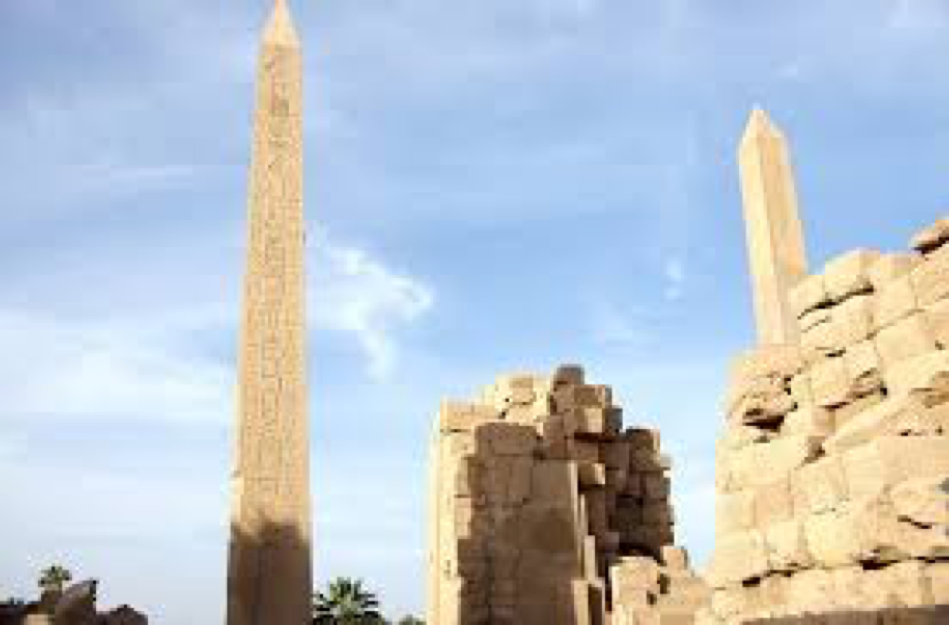
    Let me back up a bit, though.  It didn’t start in the Western desert.  About ninety of us started in Aswan, in the region of Egypt where there were the most temples, obelisks and symbols of the ancient Egyptian gods.  These “gods” manifest themselves right through human history, and those who seek spiritual power often gravitate back to the symbols that appeared in Egypt about 5000 years ago.  I think especially of the sun god Ra.  Here are some obvious illustrations:  As I understand it, the family of the Japanese Emperor make a covenant with the sun god and that has a direct connection to their flag and national symbol of the rising sun. 

    That symbol appears in many other nations too, including Korea.  Freemasons and others have recognised the power in the symbols of ancient Egypt, so a couple of centuries ago they exported the obelisks from the Luxor region to the financial capitals of the world at that time.  These obelisks still stand in London, Rome (which has eight), Paris and New York; in fact about 25 nations have obelisks in their capital cities. These were all very important symbols of prosperity in the eyes of Freemasons, and so a huge amount of effort was put into dismantling, transporting and reassembling them all across the world.

    A SIGN TO US?

    To the modern mind symbols like that often don’t make immediate sense, and yet we see the significance of symbols throughout the Scriptures.  A central command of the Ten Commandments that God gave is that we should have no idols, and when you stop and think about the Biblical stories they are full of physical objects and acts that seemed to have direct spiritual power.  I am deeply convinced that some material objects represent a direct connection to spiritual power.  Interestingly, on the first day we began to worship in Aswan, with a number of Japanese believers present, a recently-erected 40 ton golden statue fell face downward in Okinawa.  It was exactly like the story of Dagon in Judges 16.  If you do a google search you can see a picture of it.  The statue was 38 metres high (125 feet).

    Here is what I think was going on both in Aswan and in the Western desert.  Firstly, Egypt is a spiritual “mother” nation, and is the source of historical spiritual power, but can also be a mother of nations for blessing.  We gathered in Egypt because we were convinced that God had said to do so, but gathering in Egypt alone does not give you power.  What gives power is when people come together across the usual social divides:  those can be national, racial, cultural, linguistic, economic or gender.  The list could go on and on, and has to include age.  I have been in many of these prayer and worship gatherings now, and the most notable characteristic of them is family affection.  When God’s people come together and bridge all the usual divides which cause conflict, then we fulfill the condition for exercising the authority that Paul describes in Ephesians 1 and elsewhere, when he says “we are seated with Christ … far above all principalities and powers”. 

    ARE WE UNDER OR OVER?

    We can get used to operating under the spiritual powers, and the divisions, suspicion, fear and even violence that they foster between different groups.  But the Body of Christ is called to oneness and interdependence across all these divides.  From that place we have the authority that the Bible describes. Sadly, we too rarely rise to that high calling of authority.

    So that is what we did in Egypt.  We let the Holy Spirit lead without a pre-planned agenda, and we ended up with a sense of God speaking into various nations, including China, Japan and Korea, but also with a day-long emphasis on the entire continent of Africa.

    I have to add one thing, otherwise these events could appear to have no direct application.  The Lord did bring a lot of encouragement to the Egyptians, who have experienced great discouragement and despondency, especially in the last decade or so. The Christians there are discriminated against, and the nation itself has experienced one huge setback after another. 

    So there were many words of encouragement to the Egyptians, but it was not only that.  On the second to last day, a soft-spoken Sudanese pastor stood to describe how much racial discrimination he had experienced at the hands of Egyptians, including the Christians.  It exposed another divide that God wanted us to close.  The Egyptian response was deep humility, worship, repentance, and asking forgiveness, not only of the Sudanese who were there but all the Africans, as they realised that they had discriminated on the basis of skin colour.

    Throughout the four days, we did not seek to address any of the spiritual forces, but we focussed on worshipping Jesus. As we did so some of these issues of division were dealt with indirectly and, I believe, the kingdom of darkness were dealt a mighty blow.

    The principalities and powers are forces of division, fear, hatred, and violence—all towards the end that the image of God would be eradicated from the earth.  However during a few days in the deserts of Egypt under a burning sun, we bridged  many of the divisions, and it seemed that God smiled—then He achieved some of His purposes all over the earth because a group of His people really did act as His body with Jesus as the Head.

    Lynn Green.

  • Interview with the Executive Chairman of YWAM, Lynn Green

    Interview with the Executive Chairman of YWAM, Lynn Green


    Youth With A Mission, one of the largest youth and missions organizations around the world with members and missionaries stationed in over 130 nations, recently began a prayer initiative to seek God’s guidance and vision for the ministry.

    Called “50 Days of Prayer,” the initiative calls on the tens of thousands of YWAMers all over the world to set aside the 50 days between Easter Day and Pentecost to fast and pray together “for a fresh word from God” to the mission.

    Last week, about halfway into the 50-day initiative, YWAM‘s Executive Chairperson Lynn Green shared with the Christian Post the secrets to the ministry’s success: vision, strategy, mission and diversity.

    The following is the full text of the April 20 interview:

    How would you describe YWAM’s organization?

    It’s hard to say because it’s so diversified. It’s best to think of YWAM as a movement made up of missions, from nation to nation. In each place,YWAM would be seen as indigenous. They think of YWAM in England as an English mission or YWAM Indonesia as an Indonesian mission, but we are very strongly tied together. That’s by virtue of our staff, who go through a six-month discipleship school before they start. That gets everyone tied together. And because it is indigenous in nature, YWAM will do whatever the priority is for that nation. For example, in Brazil, it may be sustainable development, but in England, the focus is church planting and youth mission… whatever may be the greatest need.

    Who makes up YWAM?

    The greatest number of people joining YWAM will always be young people, but our staff ranges from people aged 8 to 80. Our primary calling is the youth because we realize that most people make those life-changing decisions when they’re young. However, there are also whole families who are part of YWAM.

    What about the University of Nations? Is that YWAM’s own university?

    University of Nations is the organization under which nearly all of our training comes. It’s a network of courses – tertiary educational courses – that are available and are in over 80 nations in the world. We have hundreds of courses, which are all modular. You might study something called graphic design, frontier in mission planting, or cross-cultural skills. Each modular study goes towards a recognized degree for U of N. Actually for our students to graduate, they need to take courses on at least two different continents and in several nations. We want people to keep growing during their whole lives, and in a very global way, to become citizens of the whole world.

    I read that the founder, Loren Cunningham, had an actual physical vision from God to start YWAM when he was in college. Can you tell us about that?

    The vision was really a picture that he had in his spirit. It was a globe – as if seen from space – and there were waves lapping each continent, and each wave would come up further inland until he saw that each continent was completely covered. Upon closer inspection, the waves were actually young people. He knew then that the young people would be taking the gospel to the world.

    What is YWAM’s commission?

    It goes back to that picture of the waves of young people covering the continents – that is – to take the good news of the gospel to the world, and as we’ve grown, we realize that the gospel is good news in every area of society. It’s not just good news about personal salvation. It’s good news to resolve injustice, to resolve freedom, to set people free from exploitation and abuse… The gospel has a greater depth than what we understood 40 years ago. We are increasingly mobilizing young people to make a difference, not just in church planting and evangelism, but also in social justice. By getting involved in education, by penetrating the areas of media and entertainment and getting the Christian message across in music, film, and theater productions, YWAM has become much broader and deeper at the same time, especially in the last two decades.

    Why do you think the youth are so important to be used by God?

    It’s not exclusive to the young people, but even biblically, most people have a sense of God’s calling when they’re young, and there’s a simple reason – God wants us to know and serve Him from when we’re young.

    There are certainly generational gaps. How can we address this issue?

    I think that the differences between generations continues to grow and the gap between generations tends to widen, but we have to work at that. It’s so easy for the older generation to dismiss the changes of the younger generation as being unexplainable or as wicked, but because intergenerational change is happening so fast, it’s a danger for us not to work at this. Being able to identify with the youth culture and communicate the gospel into it without being dismissive of the culture is pretty important.

    How do you propose to do that?

    To be humble, good listeners, and try to get under the skin. Treat it as a cross-cultural experience, as if you were reaching another nation and give them the same sort of respect. That way, we learn before we pass judgment. We are usually too quick and only have a superficial look at the youth.

    Many people believe that the post-modern culture has been a very negative influence on young people’s faith. Do you agree?

    I think that there are many positives to post-modernism. The youth don’t have the same confidence in scientific materialism, which blinded the eyes of three or four generations. They don’t have the same confidence that material advancement equals personal advancement. Therefore, there is a hunger, an interest.

    They also look for the truth in stories. They are a story-oriented or narrative-oriented society. They’re looking for the meta-narrative that makes sense, over all the other personal stories. Of course, that’s the gospel! It’s really significant that the head of the Christian message is a story. It’s a story about a man in an insignificant town in an insignificant of province in the Roman Empire. I think we have a generation who are very interested in a story and when it becomes their own story, then there is great passion. That’s very positive. Then, they can talk about the universal truth. ‘You know this thing you found? It applies to everybody.’

    I think the emphasis they have on living with authenticity is good. If you believe it, then live it, and that’s just great for the gospel.

    What is one project which YWAM is involved in currently?

    One of the most interesting projects is the prayer project, 50 Days of Prayer. That was something that we just felt – when the leadership team met last August – that God has called us to a season of fasting and praying.

    We’re trying to pray for the whole world to a level of detail that hasn’t been done previously. We have 4,379 omega zones to pray for, and we’ve got that down under 3000. It’s a great project because people are able to log onto the site and view their prayers and see what other people have prayed for, as well as strengthen our calling from God.

    And it’s working! We’re moving towards 3,000 registered users on the site. It’s working now that we are halfway through, and it’s quite clear that God is saying the same thing all over the world through other prayer projects.

    What He’s saying is that we have to become more Christ-centered and to have complete transparency and integrity. This is especially about letting God re-examine our hearts and convict us in a way of how we have become divergent. This is about realigning our actions with the Word of the Lord. When you get to the end of the book of Deuteronomy, you get this summary of God’s word to Israel: ‘Be careful and do.’ We need to consciously remember to do what the Lord has said to us. This is the most important thing about the 50 days and after that is praying towards all those parts of the world and that we go to all those parts of the world.

    Have you heard of the Global Day of Prayer?

    I was involved for 15 years with March for Jesus, which is very very similar [to Global Day of Prayer]. We had 12 million people in 177 nations all praying in one big ongoing prayer meeting. The Transform the World prayer is also very similar. We started in 1987 in London, and we had a commission from the Lord to go on until the year 2000. We did exactly that. We continued to organize national days of prayer and citywide days of prayer. We had 177 nations, and 1000 or more cities where people were praying, 12 million people on one day. We felt that the prayer movement was to finish in 2000. It seems to me that He found Graham Power and continued the prayer movement. When we asked him his method and vision, and everything, it’s all exactly the same, even though we hadn’t had any direct contact before he got started. It seems to me that God spoke to us in 1987, and God spoke to Graham in 2000, and we can’t take any credit for it. God spoke and the same thing is happening.

    What about the recent tsunami? What is the YWAM response to that devastation?

    Because of the indigenous way YWAM is organized, we have lots of teams alleviating the tsunami devastation. We’re very grateful that our teams all survived and went straight into relief work. Because they’re indigenous and were there before tsunami, they will be there for a long time. We’re well placed for the long-term relief work for these communities over the next ten years. Therefore, YWAM‘s profile as a movement to provide relief and ongoing development should be raised at this time. We have literally thousands of people who are involved in sustainable development, such as creating jobs and building schools.

    How is YWAM similar or different from other ministries/groups?

    I think God brings to birth movements. They may become denominations, organizations, local churches, but God sets into motion, or He births movements or organizations and YWAM‘s DNA has been this way. A YWAMer will feel different, not better or worse, but different. It’s like what makes a person a member of the same biological family. There is lots of diversity in some people.

    I know ministries have been working together more cohesively than before. Does YWAM follow that pattern?

    We are almost always working in coalition with somebody. Where there is already a church established, we work with the local churches. We are very reluctant to do something without the existing church. We also work with other organizations. Nearly every YWAM leader I know sits on boards of other commissions.

    Can you tell us about YWAM’s growth over the past few decades?

    It’s growing so fast, we can’t even keep track of it. We’re not even sure of our full number of staff… My job is to update the mechanisms so that we can keep track of all the people. My current project is to get our measures to speed with what is happening.

    The areas that are growing fastest are non-Western: Brazil, India, Nepal, and Korea throughout sub-Saharan Africa.. These are the places where YWAM is growing very fast. We’re growing all over the world, but in Western nations, growth is slow.

    Why do you think that this shift is occurring?

    I think that the spiritual momentum in the Kingdom of God has shifted to the non-Western world, to the south. Most of the dramatic spiritual leadership that’s really making a difference is in the non-Western world, most of the church growth is in the non-Western world, and most of the nations that are moving toward the Christian faith are non-Western, while the Western world have been Christian and statistically, are moving away from it.

    Places like Brazil are beginning to have a relatively new feeling, that they can impact the world, that they have a capacity to send missionaries, which they wouldn’t have recognized 20 years ago. In fact, YWAM has sent out 2000 people from Brazil. They’re doing long-term Bible translations, which will take a good 20 years to complete. They’ve gone ahead and begun such long-term projects. Also, missionaries have gone from Brazil to Portuguese-speaking places, such as Macau. We in the English world forget that still, large chunks of the world speak Portuguese.

    What can you say about the global developments over the past few years?

    I think we are going through a very rapid change, for example, shifting from Western leadership to non-Western, and I think that Western institutions and academics have been very slow to recognize that. Very often in America, we are initiating things that are called global, but they don’t include the leadership of the south, or where they are not the majority. If you look to Africa, S. America, India and couple other places like Korea, Indonesia, and Philippines you’ve got the majority of the Christians in the world. They are producing outstanding academic theologians, leaders, etc. We are slow to recognize this, but the leadership has shifted. A huge factor of that is China, which we don’t have the chance to interface with yet, but we will have. I think it’s important for us from Western backgrounds to learn all we can from non-Western leadership and get in on the anointing of the sense of God’s presence that so many of them carry. There is faith. There is a Biblical orthodoxy about them. They are not under seed that are divergent from Scripture like the way Western churches are. I think we just need to recognize that there’s where the leadership is, and to learn and to follow them.

    Youth With A Mission is an international movement of Christians from many denominations dedicated to serving Jesus throughout the world. YWAM began in 1960 with the main focus of getting youth into short-term mission work.

    Currently YWAM reaches out to people of almost every age – including those past the retirement age – in over 130 countries. YWAM operates in more than 900 locations in over 140 countries with a staff of over 11,000.

    Link – https://www.christianpost.com/news/interview-with-the-executive-chairman-of-ywam-lynn-green-13425/