**This is a personal website and reflects my thoughts and convictions. It does not represent any official position held by Youth With A Mission.**

**This is a personal website and reflects my thoughts and convictions. It does not represent any official position held by Youth With A Mission.**

**This is a personal website and reflects my thoughts and convictions. It does not represent any official position held by Youth With A Mission.**
For the past 46 years my wife and I have worked with a person who knows she has a high calling. God gave her gifts for this calling, and the ministry she has exercised fits who she is and gives her a sense of fruitfulness and satisfaction. That is the way it is supposed to be in God’s economy; he designs us with specific qualities to match His plans for us and to make us fit well with others who have different abilities.
A DEMANDING RANGE OF SKILLS
A few years before she came to YWAM, she trained and then practised as an executive secretary. When she arrived I had no idea how much she would change our lives and increase our effectiveness. In those days secretaries were honoured in the workplace; it was a respected and essential position in most companies and organisations. Secretarial skills required time and hard work to perfect, and anyone aspiring to that role had to be intelligent with good social skills. They had to have good spelling, grammar and typing and they had to master shorthand—a completely different way of writing! They also had to be able to keep confidences, be a source of wisdom in sensitive conversations, and extend a sense of welcome to anyone contacting their office and the person they served.
TRAINING ME!
No digital assistant can do what a secretary does.
In my case, my secretary also had to train me and I am sure that more than one “boss” was mentored by his or her secretary. I had never dictated letters before and it was an uncomfortable exercise. When I had finished a paragraph and she had taken it down in shorthand, I would sometimes ask; “How did that sound?” She often replied with a gentle correction; “Perhaps you could say it this way….” Then, when I was finished, she knew exactly how to layout a good letter and type it without mistakes. She also had the skills to sit in a board meeting, take notes and produce an accurate record of the meeting in the form of minutes. What a treasure!
Then, along came personal computers, personal digital assistants, smart phones and some wonderful communication tools. It seemed secretaries were no longer needed. But I recently read an article where the author expressed exactly how many people feel these days. She wrote that she has five PDAs, including Siri and Cortana, but complained, “So why do I get so little done?” It’s because she doesn’t have a secretary! No digital assistant can do what a secretary does.
FITTING TOGETHER AS BODY
God designed us so that we need one another. When Paul wrote to the Romans and Ephesians, he made it clear that we can only live well and fruitfully when we see ourselves as part of a body (or you could say team). God has designed people with a wide array of gifts, and no number of digital assistants can come close to the effectiveness of people working together according to the gifts God has given.
The letter to the Romans lists a number of ministry gifts in Chapter 12 and the second one is the gift of helping: “If your gift is serving others, serve them well.” A good and contented secretary will almost certainly have the gift of service. If that person has applied themselves diligently and acquired the skills of a secretary, then their service will “bear much fruit”, as the scriptures say.
At this stage of our lives, Marti and I spend quite a lot of our time training younger leaders and we get to know their joys and their pressures. One of the most common pressures is stress and stress often comes from doing tasks we are not gifted or skilled to do. Many people who carry leadership responsibility actually spend much of their time, typing emails and texts, organizing their schedule, coordinating dates and invitations and other arrangements for meetings, booking transportation, keeping accounts and many other administrative tasks. Good leaders rarely have the gifts and skills to do those things well; they need others to serve alongside them.
HONOR TO WHOM HONOR IS DUE
On the other hand, I think there are those who do have the gifts to do those essential administrative tasks, but they are often not available. Why? Perhaps it is because we think digital tools have made secretaries redundant so people with the gift of service are no longer drawn to that role. There is probably a more likely reason. Paul addressed it in some measure when he wrote about spiritual gifts in his letter to the Corinthians. He said it rather bluntly when he said;
“In fact some of the parts of the body that seem weakest and least important are actually the most necessary.”
Given the way people think, some of the spiritual or ministry gifts get more honor than others. Those who have a healing gift, or a leadership gift, or a teaching gift, get recognition and honor because they use their gift in public. Not so for those who serve at a desk.
We are created with a need for some measure of recognition and honor; it’s not wrong to feel that need. So, as Paul suggested, those with the gift of helps should be given special honor. If we honor that part of the body more, then we will see more people using the gift of service they have been given and some of those will also put in the effort and hours to acquire secretarial skills.
BETTER TOGETHER
I can now look back on 45 years of ministry in YWAM. Because God gave me a wife who is both a secretary and a very good organiser, and Terry, a secretary who is highly skilled and has served with us for 43 years, we have been immeasurably more fruitful then we could ever have been otherwise. Many people who know me think I have been very fruitful but it’s simply not true. WE have been fruitful! I am part of a body/team and, as we have all worked according to our gifts, fitted together with one another in harmony, we have indeed been very fruitful decade after decade.
Long live secretaries!
Lynn Green.
**This is a personal website and reflects my thoughts and convictions. It does not represent any official position held by Youth With A Mission.**
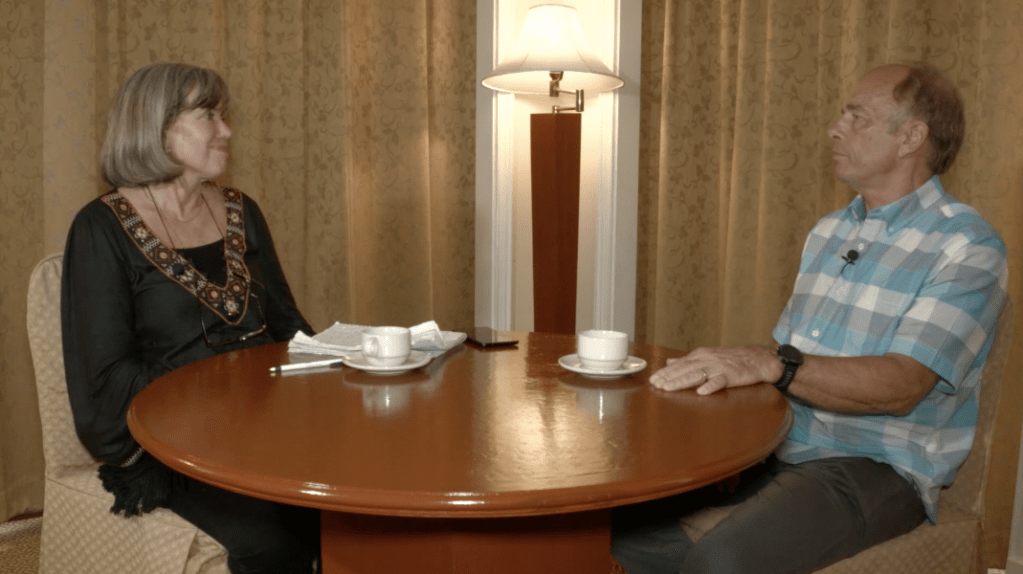
Lynn Green with Lis Cochrane about eldership in YWAM (Part 2)

**This is a personal website and reflects my thoughts and convictions. It does not represent any official position held by Youth With A Mission.**
A woman gathers her courage and decides to use Twitter or Facebook to tell the story of when she was sexually assaulted as a teenager. What response can she expect?
The current social environment means that she will probably be commended for being so brave. Her message will be re-tweeted, her post will be shared. She will get a large number of likes. With this encouragement she decides to name the man who assaulted her. Someone else then finds out where he is now and posts that information along with a picture of him.
What happens to him? Most of us would think that whatever happens to him will be deserved—and probably more! Let’s say he loses his job at the charity/non-profit where he works, then his wife confronts him and his children are deeply embarrassed and lose confidence in their dad. The family breaks up. Some men in these circumstances have committed suicide. Does he still deserve it? How does the woman who accused him feel? She says he destroyed her confidence, will this rebuild it?
MORE QUESTIONS THAN ANSWERS
Is it ever possible that the woman could have a different reason for holding a grudge against this man? Is there even a remote chance that he is innocent of the charges? What does sexual assault mean? It covers such a wide range of unwelcome and damaging behavior! Most of that wide range of acts can be devastating to a woman, especially when she is young, innocent and unsure of what is really happening to her. Some acts, at the other end of the spectrum, can even be innocent in intent but misinterpreted.
From my perspective, the vast majority of women who go public with a charge of sexual assault will be telling the truth. That is because there is a great cost to going public and, sadly, little chance of the person assaulting her being convicted. (More on that later.) However, the recent high-profile charges against powerful men have made it less difficult for women to make statements about sexual assault. That is a good thing!
But it also opens the door a bit wider for spurious allegations. Let’s say that over 95% of women who say that they were sexually assaulted are telling the truth; what do we say about the 5% where the men are innocent or there is mistaken identity? When the allegation gets social media interest, and sometimes print or broadcast media, the accused is almost always assumed to be guilty.
ACQUITTED BUT STILL PUNISHED
Here in the UK, the reputations of several high-profile public figures have been unfairly destroyed by the media identifying and publicizing the name and photos of the accused. After many months or years of investigations, the police or courts have dismissed the allegations as having no substance. Usually though, the original allegations get a lot more media coverage than when the case is dropped. In some cases, the accuser has been shown to be an attention-seeking or vindictive individual. But we all tend to rush to judgment against the more powerful person. In our Western cultures, most of us have a very strong, emotional bias for us to always believe the person who is the least powerful. I think that is because, in a culture influenced by the Bible, we have a bias towards protecting the weak or powerless—and that is also a good thing.
However, God speaks to Moses in
Leviticus 19:15 and says, “Do not twist justice in legal matters by favoring the poor or being partial to the rich and powerful. Always judge people fairly.”
JUSTICE DERIVED FROM THE BIBLE
The Bible is a primary source for our legal system and this passage is one of the more important ones. It is the reason why, in classical art, Justice is always pictured as a female who is blind-folded. She also has a set of scales in her left hand and a sword in her right hand. It symbolizes the principle in Leviticus 19; she does not judge on the basis of whether people are more or less rich, more or less powerful, young or old, male or female or any other basis for identity. She weighs the evidence and executes justice on that basis.
The very low rate of convictions in cases of rape or sexual assault is the result of another fundamental principle of justice. Every person must be considered to be innocent until there is sufficient evidence to conclude that they are guilty. One person’s word against another is not enough. There must be either witnesses or convincing evidence.
Sexual assault usually occurs when there are only two people present. In addition, most of the recent high-profile allegations are about events that happened years ago, so there is no evidence and usually no witnesses. Another foundational principle of justice from scripture is
Deuteronomy 17:6, “You must not convict anyone of a crime on the testimony of only one witness. The facts of the case must be established by the testimony of two or three witnesses. ”
These are well-proven, essential principles of justice. They are essential to Western democracies with law and order and they come from Biblical Christian influence over hundreds of years. We ignore them at our peril, even though social media tempts us to pass judgment without witnesses or evidence, but because we want to believe the less-powerful against the more powerful. Whatever the reason for the rush to judgment via social media, it has become a scourge in our society. I am not sure what we will do about it, but we will have to eventually do something.
BETTER PERSONAL RESPONSES
In the meantime, we can hold ourselves accountable to the proven principles of justice. When we read accusations or allegations online or in the more traditional media, we can remind ourselves that we don’t know what really happened but we can hope that a fair process can be played out so the guilty are found guilty and the innocent are not punished.
STILL FRUSTRATED?
You may have read this article thus far and found it quite frustrating because these principles of justice are so likely to allow many guilty people to go free. But that is not actually true. Our courts and other legal processes are far from perfect, but are not the final judges. King Solomon understood that well and when he dedicated the Temple. He and his people had labored to build it over the previous seven years. When the day of dedication came, he prayed,
“If someone wrongs an innocent person and is required to take an oath of innocence in front of your altar in this Temple, then hear from heaven and judge between your servants—the accuser and the accused. Punish the guilty as they deserve. Acquit the innocent because of their innocence.” 1 Kings 8:31.
JUSTICE WILL BE SERVED
If a crime has been committed and there is no evidence and no credible witnesses, and the accused lies under oath, that is not the end of it. God sees and He is the final Judge. Remember, though, that His justice is sure even though it is not always immediate.
Ecclesiastes 8:11-13 says; “When a crime is not punished quickly, people feel it is safe to do wrong. But even though a person sins a hundred times and still lives a long time, I know that those who fear God will be better off. The wicked will not prosper…”
The ultimate Judge will punish the wicked. On the other hand, God is on the side of those who suffer and he promises that He can make
“…everything work together for the good of those who love God and are called according to his purpose for them.” Romans 8:28.
When seen in the light of God’s character and His promises, we needn’t become angry, bitter and judgmental. We can actively trust Him, knowing that He sees. We needn’t rush to judgment with the angry herds on social media, or believe all that we see, hear or read in traditional media.
Thank God that He is the all-knowing, merciful and final Judge!
Lynn Green.
 Lynn Green