Tag: YWAM England

  • Faith and Finances

    Faith and Finances


    **This is a personal website and reflects my thoughts and convictions. It does not represent any official position held by Youth With A Mission.**

    Hi welcome again. I talked awhile ago about faith and finances and emphasized that we’re not looking for a methodologies but rather we’re looking for God’s provision and it comes in many different ways. But at the time when Marti and I were really struggling financially we started to learn some principles. Now let me say something about principles.

    We don’t take the way God has dealt with us, turn them into principles and then live by those as rules or law. We “live by every word the procedure of the mouth of God.”

    So when I talk about principles, they may be something God would want to say now to others but they’re not rules and they’re not magic formula for making finances work. But here are things God dealt with us about, and I think they’re quite universally important.

    Firstly, we were really struggling with finances and it had been a period of over 10 years. I began to realize, talking with with a good friend Barry Austin, that I had become, and Marti felt the same, receivers not givers, and God wants us to be givers.  That is true for all people, even those who live by God’s provision which usually through other people’s giving.

    We are also called to be givers.  Sometimes, because we’re struggling financially we stop being generous.  Being in debt makes it really hard to be generous. So stay out of debt. And if you’re in debt make it your first priority to get out of debt.

    If you owe people, or banks, or credit cards, then it feels like you’re giving away other people’s money. That’s right!  You can’t give away money that you owe to others.  So get out of debt.

    We had always tithed because both of us learned that discipline when we were young.  If you’re not tithing by all means start laying aside 10% of any income and give it as the Lord shows you.  But we felt like the Lord challenged us to increase our tithe. (Tithe actually means 10%, so to increase it is kind of a misnomer.) We increased it to 15% and then we felt like God said increase it again, increase it again, increase it again.  We began to give a larger and larger percentage of everything that came into us. Over about a two year period we began to give a lot more money away than we had ever thought we would be able to give away.  Because we did that first, it seemed God really blessed that. During that-two year period we moved from just barely getting along to having sufficient for all of our needs plus money to give away.  So that was one of the keys.

    I’m sure that not everyone should do it that way, but the principle is right and the idea is right.  God wants us to be generous. If you’re not being generous then perhaps you have a “receiving mentality”.  Here is a way to test that:  If you meet people who you think are wealthy and then you think, “maybe they’ll be a supporter”,  that’s a sign you’re a receiver.  You want to get out of that frame of mind and  spirit because God loves cheerful givers.

    I’m sure He likes us to cheerfully receive too. But its generosity which reflects God’s character and person. The second thing that God dealt with us about was helping people to not just give, but to feel that they are a port of what we are called to.

    We want to be team with people and to do that you have to communicate, and communication is something that requires self-control and discipline.. Ask people if they’d like to stay in touch. And thenkeep the contact. And then and then you need to write letters that are reasonably personal to them. Then. I would do a regular newsletter that we try to keep as personal and self revealing as possible and descriptive. So people really felt they were part of our lives. But then we were also Marti especially would write personal handwritten notes on the bottom of those. So you know we started off with maybe I don’t know 20 people or so. And then we added and it was between two of us. You may say I don’t have 20. Well maybe not. You might have five. But if you’re coupling between two you might have 10 or 15 or 20 and start there and write those personal notes and communicate well and get people feeling like they are really part of your team and that. They should and can be praying for you on a very regular basis.

    So those are two of the things that really helped and I’ll talk about another one but I think I’ll save that for the next video.

    Lynn Green.


  • The Revolutionary Changes in YWAM Leadership

    The Revolutionary Changes in YWAM Leadership


    **This is a personal website and reflects my thoughts and convictions. It does not represent any official position held by Youth With A Mission.**


    A few years ago I spoke with a very experienced Christian consultant.  When I explained the changes we were beginning to implement, she said it was probably to revolutionary and we were not likely to survive the chaos.  We have survived and thrived because it was God’s idea and God’s time.  But we are still explaining the implications of moving away from organizational thinking.  So, here is another important subject:

    Has YWAM done away with Hierarchy?

    Is there any real leadership beyond local level in YWAM? I have spoken to quite a few people who have the impression that we have done away with all leadership and accountability beyond the local. What they often say is that “there is no hierarchy in YWAM”, but is it true?

    What we have done away with is positions and titles that tend to make hierarchy organisational and often rather ridgid.  But that does not mean we have done away with hierarchy.  In fact, human beings cannot do away with hierarchy.  Jesus certainly did not dispense with the idea. You will recall that when a couple of his disciples were arguing who is the greatest, he didn’t say none of you will be greater than the other, he said if you wish to be greatest you must be servant of all.  So what does that mean?

    It’s about influence

    When we think about it, some people have a lot more influence than others.  That is hierarchy; we might call it “social capital”.  Since there is hierarchy, based upon influence, or social capital, we must ask how the power of that influence can be used so it is not damaging.  Again, Jesus made that clear—when it is exercised from a servant-heart, we all welcome it.

    The attempts to deny the existence of hierarchy or efforts to do away with it usually come from people who have been hurt by other people with more influence or power than they have, or perhaps they are just envious. But to try to do away with it is to do away with human nature and that can only be done with imposing more power and that is tyranny.

    Influence is given, not demanded

    Hierarchy exists because we respect and listen to some people more than others. But why is that?

    Again, if we stop to think about it, some people have more influence than others, especially in our circles within the body of Christ, because they exhibit Christ-like character; because they are humble and trustworthy; because they demonstrate wisdom and because they have God-given gifts which equip them to lead.

    Hierarchy cannot be eradicated

    To be very practical, I would guess that everybody in YWAM would tend to pay more attention to Loren Cunningham than anyone else.  That is only right.  We pay close attention to what he says because of the fruit of his life and because he has consistently been prophetic in his major public statements.

    Since hierarchy exists, we have to ask how we can recognize it without it becoming ridged and potentially damaging.  The damage often occurs when a title or position extends more power to an individual than they actually have or deserve in the eyes of others.  That is exactly what we are trying to avoid.

    Keeping it friendly and appropriate

    We have done this partly by moving away from organisational titles and positions to eldership (beyond the local level).   “Elder” should not designate a position or title; rather it is recognition of social capital as described above.  The extent of that social capital will vary from one elder to another. A person who is, in effect, an elder in a team is a person who is more mature than the others and people listen to her or him more readily.  But the person who is an Elder in that team is often not an elder in a wider context.  So eldership is situational and we should recognize that.

    Everybody should acknowledge those people in their lives whom they trust, who have wisdom and authority and to whom they look for counsel.  Each of us should also relate to those who can correct us and call us to account if and when needed.

    Who are your elders?

    So, to summarize:  YWAM has not done away with leadership, authority and accountability.  Rather, we have turned away from the common tendency to add organizational power via titles and positions.  Elders/leaders still exist by virtue of the “social capital” that arises from who they are.  We will continue to urge all who lead in YWAM to do so from a servant heart.

    We will also urge every YWAMer to submit to God-ordained authority in their lives.  We can only live healthy, Christ-centered lives when we have heart connections with many others in the Body of Christ and that includes elders.  Each and every person and leadership team should be able to identify their elders.

    I hope we agree that servant-hearted hierarchy is a very good thing!

    Lynn Green.

  • Global Guilds

    Global Guilds


    **This is a personal website and reflects my thoughts and convictions. It does not represent any official position held by Youth With A Mission.**

    In recent years, many Christians, especially the young, have begun to understand that God’s purposes encompass all of creation and that includes all the spheres of social influence. Practically, that concept means God calls His people into government, education, business, the arts, entertainment and sports, media and communications etc. These Christians realize that all these vocations are equally as significant as a call to local church ministry or world missions.

    Though this understanding of the all-encompassing nature of the Kingdom of God is spreading widely, many still feel isolated and unsupported in their vocation. They may have embarked upon a career in government or education or entertainment or the news media—but a large majority of these committed Christians feel under-supported in their vocation.

    Many centuries ago committed disciples of Jesus banded together in supportive, worshipping communities and formed what became known as guilds. As illustrated by the following quotes, the initial purpose for the formation of guilds was that practicing Christians in the same craft or service could support one another in their faith.

    “They were voluntary associations or fraternities and in the first instance their objects were religious and social. The craft element grew almost as an accidental feature, largely because people of` the same craft tended to live in the same neighbourhood in those days.”

    “However, after the Dark Ages it is known that the early guilds in London evolved from a purely religious basis when craftsmen in specific trades tended to congregate in a common area for both practical and mutual convenience. To some extent this still appertains today – for example in Hatton Garden. It is natural therefore that the members of a particular craft who worshipped together at their local church should form a community of interests and it was from these religious congregations that voluntary associations (as opposed to the compulsory ‘frith guilds’ of Saxon times) were formed for the mutual aid and protection of their members. These fraternal bodies of Guild took their title from their patron saint, and the guild of bakers was known at least until mediaeval days as the ‘FRATERNITY or GUYLDE OF OUR LADY AND ST. CLEMENT’.

    The spiritual connotation is perpetuated to this day in the title ’Worshipful’ and in the Company’s motto ‘PRAISE GOD FOR ALL’, which is also the traditional grace used before all meals.

    The guilds, in the course of the following centuries, became instrumental in the transformation of London and served as the foundation stones upon which the prosperity and global leadership of the City of London were built. The guilds grew in influence and leadership until they became the structure by which the City of London was governed.

    Because of this strong religious and ethical foundation, the City of London operated primarily on a basis of integrity and trust until as recently as the last quarter of the twentieth century.


    Trust-worthy people are the greatest resource any economy can have. When high trust is deserved and given, overheads are reduced due to little need for self-protection; project completion times are shortened, stress is reduced and synergy between people and organisations grows hugely.

    The emerging streams of committed Christians who are pursuing their calling to the various social jurisdictions could be well served by an adaptation of the guild concept. Communication and information technology could facilitate the emergence of Global Guilds in education, government, entertainment, sports, business, health services etc. Current and developing technology could help create a sense of global community, though web-communities can only serve to network and serve real, face-to-face communities of common interest.

    This idea requires much prayer and some careful thought, assuming it has a chance of being successfully implemented in the 21st Century. For example, how would an individual or company attain membership?   In the context of YWAM perhaps successful completion of a YWAM-DTS could be a starting point? Additional very specific training would probably be required, followed by a formal commitment to a code of practice.

    The global guilds would not be simply a framework of agreement between individuals; membership would also constitute a covenant with God. With His blessing the guilds could become very influential—a transformational force among the nations.

    The web-based dimension of the global guilds could provide documentation of the agreements and values, information about resources and events, up-to-date articles and testimonials, chat rooms and on-line conferencing facilities.

    In addition to the web services, the guilds could be serviced by YWAM bases hosting events for members. The members could also form themselves together in cell groups for mutual support.

    In addition to the primary benefits of the global guilds, YWAM could contribute by being able to provide resources for the members, facilitating conferences and other events, and having strategic access to a potentially very large web community. This concept would provide a most compelling reason for YWAM alumni to remain connected and could lead to the fulfillment of a vision given to Loren Cunningham several years ago for a massive, global, online community committed to the coming of the Kingdom of God.

    YWAM Together 2016 was organized around the foundational idea behind the original guilds—that the Kingdom of God encompasses and shapes all aspects of human society. We are convinced that the Holy Spirit has guided us and will continue to guide us to serve people in their God-given vocations. The Sphere Tracks have been developed to enable members of the wider YWAM family to connect with others who have similar callings. In those Tracks networking and mutual learning will occur as an obvious outcome, but each track will also engage extensively with the Scriptures, seeking out understanding and revelation about what God has said, and is saying, about every dimension of society. The Sphere View App will be an enormous benefit as a tool to focus our engagement with God’s Word.

    Each Track can also pray together and work through the essential questions of how to move forward with some up-to-date expression of guilds. Some of the most obvious questions are:

    • Is there sufficient felt need for momentum to be created and sustained?
    • Who is committed to start and take a lead in the formation of global guilds?
    • Should local “cells” be at the heart of the movement?
    • Periodic events are needed at local, national, regional and global levels. How can YWAM serve these?
    • How can common practices and standards be developed?
    • Can/Should the guilds have the authority to enforce their standards on those who choose to join? If yes, how would that look in practice?

    Godly transformation of nations will not just happen. The entire world felt the effect of a prayer group that met in Clapham, London in the early 19th century. From that group, William Wilberforce led the global movement to abolish slavery. They also impacted education, Church life, the arts, media and business. They did not start with a grand strategy, but started with genuine Christian fellowship and commitment to prayer. From that, God unfolded a strategy that transformed a nation and that nation touched the entire world.

    Transformation is still on God’s heart today. Are we available to be used, regardless of the cost?

    Lynn Green.


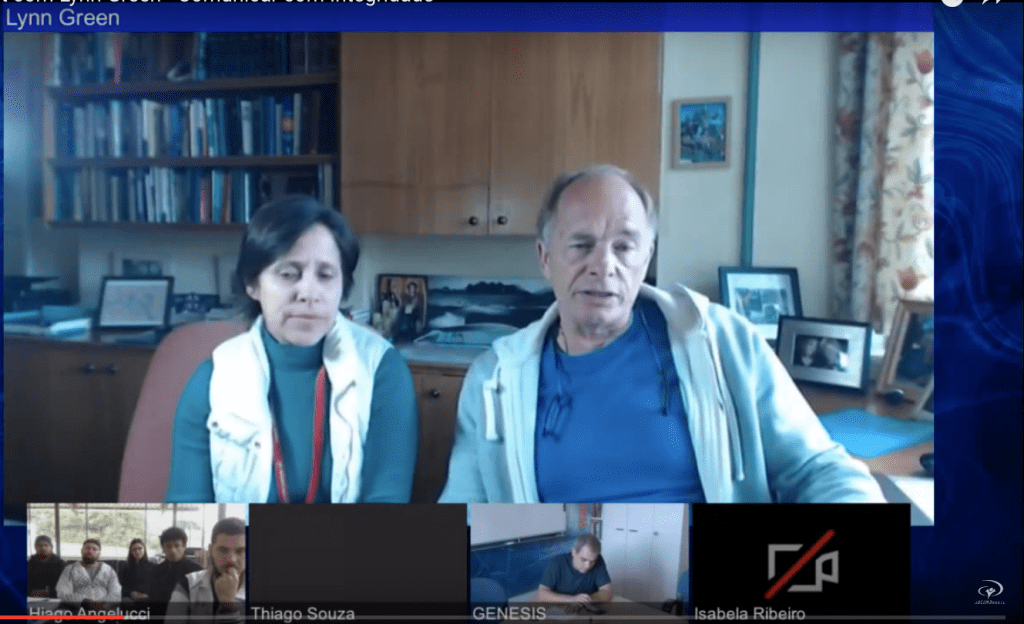
  • Hangout com Lynn Green – Comunicar com Integridade

    Hangout com Lynn Green – Comunicar com Integridade


    **This is a personal website and reflects my thoughts and convictions. It does not represent any official position held by Youth With A Mission.**